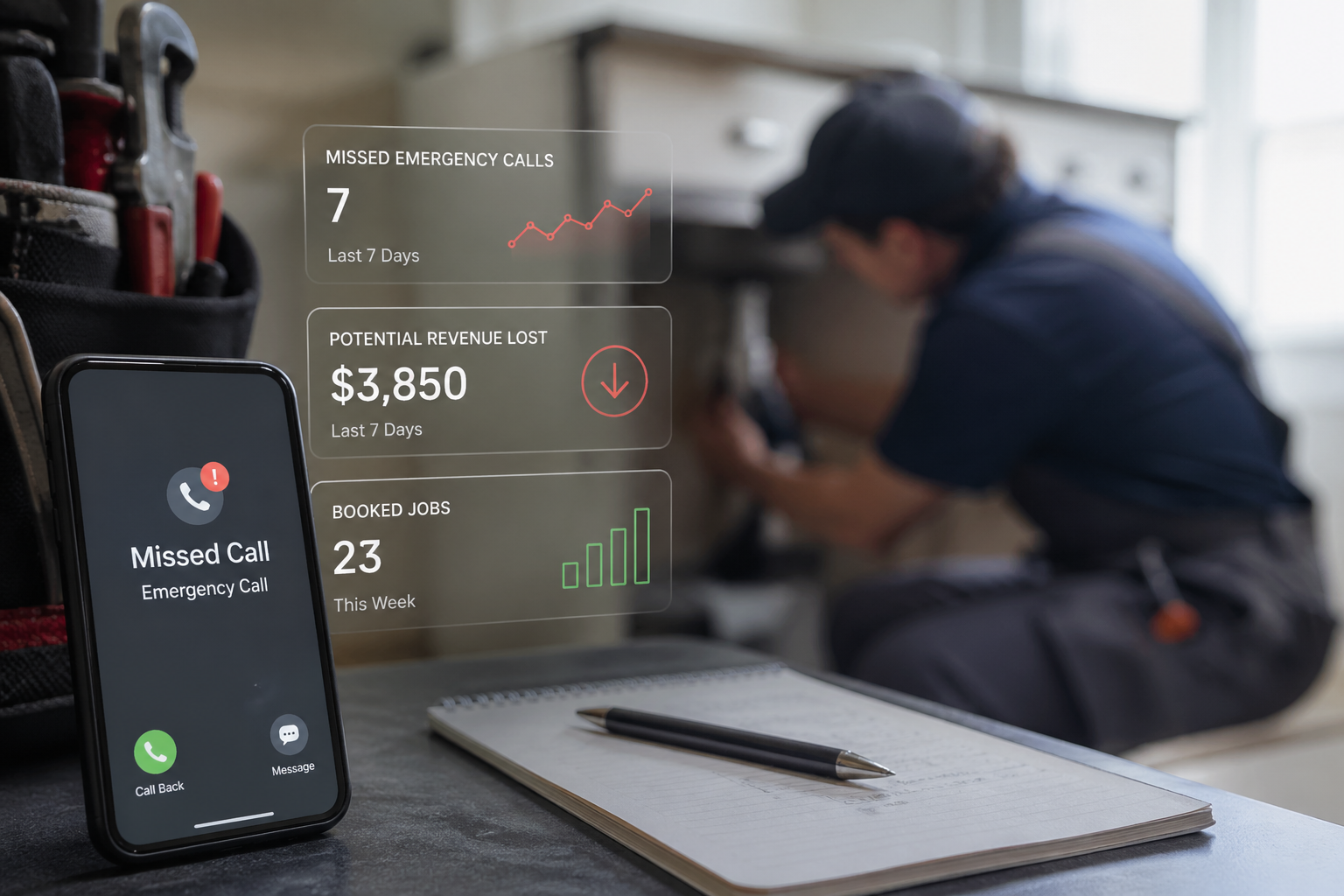
Your service bay sits empty at 10 AM on a Tuesday. Not because there's no demand—your voicemail has 14 messages from potential customers who called after hours or during your lunch rush. Meanwhile, your service advisor is juggling phone calls, walk-ins, and trying to update the schedule simultaneously. Sound familiar?
The average auto repair shop misses 32% of inbound calls during business hours, according to industry data. Each missed call represents approximately $450 in lost revenue—that's the average repair order value walking out the door. For a shop receiving 50 calls per week, that's over $7,000 in monthly lost opportunity.
Here's the reality: your competitors are answering those calls. And in today's market where 67% of customers will call a second shop if the first doesn't answer, being available isn't optional—it's survival. This is where an AI phone system for auto repair transforms your business from reactive to proactive, capturing every service opportunity 24/7.
Why Traditional Phone Handling Is Costing You Service Appointments
Auto repair shops face unique communication challenges that drain revenue and frustrate both staff and customers.
The Peak Hour Bottleneck
Your busiest phone times—7:30-9:00 AM and 4:30-6:00 PM—coincide exactly with customer drop-off and pick-up rushes. Your service advisor can't physically be in three places at once, yet that's precisely what customers expect. The result? Calls roll to voicemail, customers get frustrated, and appointments go unbooked.
During these critical windows, shops typically miss 47% of incoming calls. That's nearly half your potential revenue opportunity lost during your most profitable hours.
The After-Hours Revenue Gap
Consider this: 38% of customers prefer calling outside traditional business hours—during their commute, lunch break, or evening. These are often your most motivated buyers: someone whose check engine light just came on, or a driver who needs service before a road trip this weekend.
Traditional answering services might take a message, but they can't check your schedule, discuss service options, or book appointments with the urgency these situations demand. By morning, these hot leads have often moved on to shops that could help them immediately.
The Service Advisor Burnout Factor
Your service advisors didn't sign up to be phone operators. Yet they spend an average of 3.2 hours daily on routine phone tasks: answering basic questions about hours, services offered, and pricing ranges. That's time stolen from their actual expertise—diagnosing vehicles, consulting with technicians, and providing value-added customer service.
This administrative burden leads to longer wait times for walk-in customers, rushed vehicle consultations, and burned-out staff who leave for less stressful positions. The turnover cost alone—$4,000 to $8,000 per service advisor—makes this inefficiency expensive.
How AI Phone Systems Transform Auto Repair Operations
An AI phone system for auto repair doesn't just answer calls—it becomes an intelligent extension of your service team, handling routine tasks with consistency while escalating complex situations to human staff.
Intelligent Call Routing and Triage
Modern automotive AI receptionists understand context. When a customer calls saying "my brake light came on this morning," the system recognizes this as a potential safety issue requiring prompt attention. It immediately checks your schedule for same-day or next-day availability, explains the typical diagnostic process, and books the appointment—all while the customer is still on the line.
Compare this to a generic answering service reading from a script, taking a message, and leaving you to play phone tag the next morning. The AI system captures appointments in real-time, often converting 40-60% more callers into scheduled services.
For routine inquiries—oil change pricing, operating hours, tire rotation availability—the AI handles these completely, freeing your team to focus on vehicles and customers in the shop. It can even provide accurate estimates based on vehicle make, model, and service history in your system.
24/7 Appointment Booking That Actually Works
The difference between AI-powered scheduling and traditional after-hours solutions is dramatic. When integrated with shop management systems like Tekmetric, Mitchell 1, or NAPA TRACS, an AI receptionist for small business operations accesses your real-time availability.
A customer calling at 9 PM doesn't get "someone will call you back tomorrow." They get: "I can schedule your brake inspection for tomorrow at 2:00 PM or Thursday at 10:00 AM. Which works better?" The system books the appointment, sends confirmation via text and email, adds it to your calendar, and creates the repair order in your management system.
This immediacy matters enormously. Studies show that 78% of customers book with the first shop that can accommodate their schedule and confirms immediately. Speed to appointment equals competitive advantage.
Service History and Customer Recognition
When integrated with your shop management software, AI systems recognize returning customers. "Welcome back, Sarah. I see your 2019 Honda Accord is due for its 60,000-mile service. Would you like to schedule that?" This personalization creates the concierge experience that builds loyalty—without requiring your staff to memorize every customer's service history.
The system can proactively mention relevant services: "Your last visit notes mentioned needing new tires soon. Would you like me to include a tire quote in your upcoming appointment?" This suggestive selling happens naturally in conversation, increasing your average repair order without pushy sales tactics.
Real-World Impact: Auto Repair Shops Using AI Systems
Mike's Import Auto Service - Seattle, WA
Mike's shop specializes in European vehicles, with premium customers expecting premium service—including immediate appointment booking regardless of when they call.
Before AI implementation, Mike employed two full-time service advisors rotating shifts to cover 7 AM to 6 PM, plus an answering service for after-hours that simply took messages. Monthly service appointments: 340. After-hours conversion rate: 12%.
After implementing an AI phone system integrated with their Tekmetric shop management software, the numbers transformed:
- Monthly service appointments increased to 476 (40% growth)
- After-hours conversion rate jumped to 54%
- Service advisor phone time reduced by 62%, allowing more face-to-face customer interaction
- Average appointment booking time: 2.3 minutes vs. 8+ minutes previously
- No-show rate dropped from 18% to 7% due to automated SMS reminders
Mike reports, "Our service advisors can actually do their jobs now instead of being receptionists. And customers consistently comment on how easy it is to schedule with us, even at 10 PM when they're planning their next day."
Precision Auto Care - Austin, TX
This three-bay independent shop struggled with a common problem: the owner, Carlos, wore every hat including answering phones. His technical expertise was constantly interrupted by calls about oil change prices and appointment availability.
Within 90 days of implementing AI phone automation, Precision Auto Care saw:
- 156 additional appointments booked (37% increase)
- $67,000 in additional monthly revenue
- Carlos reclaimed 15 hours per week for vehicle diagnostics
- Customer satisfaction scores increased from 4.1 to 4.8 stars
- Google review volume doubled as more customers experienced prompt service
Carlos notes, "The system handles all the routine stuff flawlessly. My phone only rings now when it's something that genuinely needs my attention—like a complex diagnostic question or an unhappy customer I need to personally address."
Key Features Auto Repair Shops Need in AI Phone Systems
Not all AI phone solutions are created equal. Auto repair shops have specific requirements that generic systems don't address.
Shop Management System Integration
Your AI phone system must integrate seamlessly with your existing tools. Look for native integrations with:
- Tekmetric, Mitchell 1, NAPA TRACS, Shop-Ware, AutoFluent
- Google Calendar, Outlook Calendar for independent shops
- Payment processing systems for deposit collection
- SMS platforms for appointment reminders
Without these integrations, you're just adding another disconnected tool that creates more work instead of less. The best AI phone system integrations sync bidirectionally—changes in your shop management system update the AI's availability instantly, and appointments booked by AI appear immediately in your schedule.
Vehicle-Specific Intelligence
Generic appointment booking can't distinguish between a 15-minute tire pressure check and a 4-hour timing belt replacement. Automotive-focused AI systems understand:
- Service duration by repair type and vehicle
- Parts availability considerations
- Technician specialty matching (import vs. domestic, electrical vs. mechanical)
- Courtesy vehicle availability coordination
- Multi-stage jobs requiring drop-off and pick-up timing
This intelligence ensures appointments are scheduled with appropriate time buffers, preventing the domino effect of jobs running long and disappointing every customer scheduled afterward.
Emergency vs. Routine Call Handling
An AI system for auto repair needs to distinguish urgency levels. A customer calling about "loud grinding from the brakes" requires different handling than someone scheduling routine maintenance three weeks out.
Quality systems include escalation protocols: urgent situations trigger immediate notifications to your service manager's mobile phone, while routine scheduling happens automatically without interrupting your workflow. This balance—automation for efficiency, human involvement when it matters—makes AI practical rather than impersonal.
Multi-Location Management
Growing shops with multiple locations need centralized oversight with location-specific intelligence. Your AI system should:
- Route calls based on customer proximity or preference
- Access each location's unique schedule and capability
- Transfer complex calls between locations if needed
- Provide consolidated reporting across all locations
This becomes crucial as you scale from one location to three or five, maintaining consistency while respecting each shop's unique attributes.
Implementation Guide: Getting Your AI Phone System Running
Switching to an AI phone system sounds complex, but the process is remarkably straightforward when broken into clear steps.
Week 1: Setup and Integration
Start by connecting your AI system to your shop management software. Most modern platforms offer API integrations that your IT provider or the AI vendor can configure in under an hour. You'll authorize access to schedules, customer data, and service history—the same information your human staff uses to book appointments.
Next, configure your service menu with typical appointment durations. Oil changes: 30 minutes. Brake jobs: 2-3 hours. State inspections: 45 minutes. This duration database helps the AI book appointments with appropriate spacing.
Week 2: Voice Training and Customization
This is where you teach the system your shop's personality. You'll provide sample conversation scripts for common scenarios:
- "When customers ask about oil change pricing, mention our $39.95 conventional oil special and explain that synthetic is $69.95"
- "If someone mentions hearing a noise, always book at least 1 hour for diagnostic time"
- "Remind customers bringing vehicles for inspection to arrive 15 minutes before closing"
The best systems learn from real conversations, improving accuracy over time. You can also customize the voice tone—professional and concise for high-volume shops, or friendly and conversational for customer-focused independent shops.
Week 3-4: Parallel Testing
Run the AI system alongside your existing phone setup for two weeks. Forward calls during your busiest hours or after-hours while monitoring how the system performs. Most shops are surprised—the AI often handles routine calls better than stressed human staff during peak times.
Review conversation transcripts daily during this testing phase. You'll identify edge cases the system handles awkwardly and can refine the training. This iterative improvement is normal and quick.
Month 2: Full Deployment
Once confident, switch your main line to the AI system with your team as backup for escalated calls. Most shops see immediate impact: callers wait less, appointments book faster, and staff breathe easier.
Pro tip from successful implementations: tell your existing customers about the change. A simple email saying "You can now schedule appointments 24/7 by phone—just call our regular number anytime" turns the change into a positive customer service enhancement rather than a surprise.
Cost-Benefit Analysis: ROI for Auto Repair Shops
The numbers behind AI phone systems tell a compelling story, especially for shops currently missing revenue opportunities.
Direct Revenue Impact
Consider a typical independent auto repair shop:
- 50 calls per week (2,600 annually)
- Currently missing 30% due to busy lines and after-hours timing (780 missed calls)
- Average conversion rate: 60% (468 potential appointments lost)
- Average repair order: $450
- Annual lost revenue: $210,600
An AI phone system capturing even 70% of those currently missed opportunities adds $147,420 in annual revenue. At typical auto repair profit margins (45-50% labor, 25-30% parts), that's $50,000+ in additional profit.
Operational Cost Savings
Beyond captured revenue, AI systems reduce operational costs:
- Service advisor time savings: 3 hours daily × $25/hour × 250 work days = $18,750 annually
- Reduced answering service costs: $200-400 monthly = $2,400-4,800 annually
- Lower no-show rate: 10% reduction on 400 monthly appointments × $450 avg = $18,000 annually
- Decreased staff turnover: Reduced burnout extends employee tenure, saving $4,000-8,000 per avoided replacement
Total annual operational savings: $43,150 to $49,550
System Costs
Quality AI phone systems for auto repair shops typically range from $299-699 monthly depending on call volume and features. Annual cost: $3,588-8,388.
Net ROI: First Year
Revenue increase: $147,420
Cost savings: $43,150-49,550
Total benefit: $190,570-196,970
System cost: $3,588-8,388
Net gain: $182,182-193,382
That's a 2,162% to 2,686% return on investment in year one—and the benefits compound as customer satisfaction and loyalty increase.
Even shops capturing 50% of currently missed opportunities see 6-figure annual impact. For perspective, that's equivalent to adding a full service bay without the real estate costs, equipment investment, or additional technician salary.
Advanced Features That Set Top Systems Apart
Once basic appointment booking is working smoothly, advanced features take your customer experience to the next level.
Predictive Maintenance Outreach
The most sophisticated AI phone systems proactively call customers when service is due. "Hi Sarah, this is Precision Auto Care's automated reminder system. Your 2020 Honda Civic is due for its 40,000-mile service including tire rotation and fluid checks. Would you like me to schedule that for you?"
This proactive approach fills schedule gaps during slower periods and demonstrates the attentive service that builds customer loyalty. Shops using predictive outreach report 23-35% increases in routine maintenance bookings.
Warranty and Recall Management
When integrated with your customer database, AI systems can identify vehicles affected by recalls and proactively schedule repair appointments. "Mr. Johnson, Honda has issued a recall for the fuel pump on your 2019 Accord. This repair is fully covered and takes about 90 minutes. I can schedule you for this complimentary service—when works best for you?"
This positions your shop as the trusted advisor keeping customers informed and safe, rather than waiting for customers to notice recall notices months later (if ever).
Multi-Channel Communication
Leading systems don't just handle phone calls—they manage SMS, email, and even webchat through a unified interface. A customer might start by texting "Do you have time today for an oil change?", receive an automated response with availability, book the appointment, and get confirmation via email—all without a single phone call.
This omnichannel approach meets customers where they are, particularly valuable for younger demographics who strongly prefer text over voice calls.
Analytics and Performance Tracking
Comprehensive reporting shows exactly how your AI phone analytics are performing:
- Call volume by hour, day, and week
- Booking conversion rates and trends
- Average call handling time
- Most common customer questions
- Peak demand periods for staffing optimization
- Revenue impact from captured appointments
These insights help you make data-driven decisions about shop hours, service offerings, marketing focus, and staffing needs.
Common Concerns and How to Address Them
Auto repair shop owners considering AI systems often share similar hesitations. Let's address them directly.
"Will customers be frustrated talking to AI instead of a human?"
Modern conversational AI has evolved dramatically. Most customers can't immediately tell they're speaking with AI rather than a human—the natural language processing is that sophisticated. More importantly, customers care about results, not whether a human or AI helped them.
Consider: would you rather reach an AI that books your appointment in 2 minutes at 9 PM, or leave a voicemail and wait until tomorrow for a callback? Customer satisfaction surveys consistently show higher ratings for AI systems that solve problems immediately versus humans who make them wait.
For customers who genuinely need human assistance, quality systems include seamless transfer options. "I'd like to connect you with our service manager for that specific question. Let me transfer you now." Customers appreciate getting to the right resource quickly.
"What if the AI makes mistakes with schedules?"
AI systems are only as accurate as the data they access. When properly integrated with your shop management system and given clear scheduling rules (appointment durations, buffer times, technician specialties), AI systems make fewer scheduling errors than busy humans juggling multiple tasks.
The key is starting with clear parameters: "Never book more than 3 oil changes in the same hour" or "State inspections require appointment slots between 8 AM - 4 PM." With these rules programmed, the AI consistently applies them—something that's difficult for humans during chaotic busy periods.
"Won't this replace my service advisors?"
Absolutely not—and here's why shop owners who've implemented AI are emphatic about this. AI handles repetitive, low-value tasks (answering hours of operation, booking routine oil changes, providing basic pricing). This frees service advisors to do what they're actually good at: building customer relationships, explaining complex repairs, adding value through expertise.
Think of AI as an assistant that handles the routine so your skilled staff can focus on the complex. Your service advisors become consultants and problem-solvers rather than appointment clerks—a more satisfying role that reduces turnover and increases their value to your business.
Integration with Existing Auto Repair Tools
For AI phone systems to deliver maximum value, they need to work seamlessly with the tools you already use daily.
Shop Management System Integrations
The most critical integration is with your primary shop management platform. Leading AI systems for auto repair shops offer pre-built integrations with:
- Tekmetric: Complete bidirectional sync with appointment calendar, customer records, vehicle history, and service recommendations
- Mitchell 1 Manager SE: Access to customer database, scheduling calendar, and service package definitions
- NAPA TRACS: Integration with parts inventory, labor guide, and appointment booking
- Shop-Ware: Real-time calendar access, customer communication history, and automated estimate follow-up
- AutoFluent: Appointment scheduling, customer database, and inspection report access
These integrations mean the AI system sees exactly what your service advisors see: who the customer is, what vehicle they drive, when they last visited, what services might be due, and when you have availability. This context makes conversations feel personal and informed rather than generic and scripted.
Payment Processing Integration
For shops requiring deposits for major repairs or diagnostic fees, AI systems can integrate with payment processors like Square, Stripe, or your existing merchant account. The system can securely collect payment information and process deposits while booking appointments: "I'll need a $150 diagnostic deposit to reserve that appointment time. I can take your credit card now if you'd like to complete the booking."
This reduces no-shows for time-intensive diagnostic work and gets commitment from customers upfront.
Customer Communication Platforms
Modern auto repair relies on multi-channel communication. AI phone systems that integrate with SMS platforms, email marketing tools, and even your Google Business Profile messaging ensure consistent customer experience across all touchpoints.
A customer might schedule via phone call with the AI, receive SMS appointment confirmation, get email service recommendations, and leave a review—all orchestrated automatically to create a seamless journey from first contact through completed service.
Getting Started: Choosing the Right AI Phone System
Not all AI phone systems are equally suited for auto repair operations. Use this evaluation framework when comparing options.
Essential Criteria
✓ Automotive industry experience: Does the vendor understand auto repair workflows, terminology, and scheduling complexity?
✓ Shop management integrations: Does it connect with YOUR specific platform (Tekmetric, Mitchell 1, etc.)?
✓ Appointment booking intelligence: Can it handle different service durations, technician specialties, and parts availability?
✓ After-hours capability: Does it function identically at 2 AM as it does at 2 PM?
✓ Escalation protocols: Can it identify urgent situations and connect customers to your team when needed?
✓ Voice quality: Does it sound natural and professional, not robotic?
✓ Setup support: Will the vendor help with implementation and training, or just hand you a software license?
Questions to Ask Vendors
Before committing, get specific answers to these questions:
- "Show me a demo conversation for a brake repair booking with our shop's actual schedule integrated"
- "How does your system handle a customer calling about a check engine light who needs same-day service?"
- "What happens when a customer asks a question outside your system's knowledge?"
- "How long is typical implementation for a shop with 3 bays and 400 monthly appointments?"
- "What ongoing training and optimization do you provide after initial setup?"
- "Can I hear actual recordings from other auto repair shops using your system?"
Trial Period Best Practices
Most quality vendors offer a trial period. Use it strategically:
- Start with after-hours only to see appointment booking accuracy without impacting daytime operations
- Monitor all conversation transcripts for the first two weeks
- Have your team call in as "mystery shoppers" with various scenarios
- Track metrics: calls answered, appointments booked, customer feedback
- Compare the trial period's performance against your previous month's numbers
If the system handles 80%+ of calls successfully during the trial with minimal errors, it's likely ready for full deployment.
The Future of Auto Repair Communication
AI phone systems aren't a temporary trend—they represent the future of how auto repair shops interact with customers. The technology will only improve, offering increasingly sophisticated capabilities.
What's Coming Next
Within the next 2-3 years, expect AI systems to:
- Predict vehicle issues based on symptoms described: "A grinding noise when turning left in a 2018 Honda CR-V often indicates CV joint wear. I'm booking you for CV joint inspection with parts availability checked beforehand."
- Provide real-time repair progress updates: Customers receive proactive calls as their vehicle moves through diagnostic, approval, repair, and completion stages—without service advisors making individual calls.
- Handle insurance coordination: For collision repair shops, AI will navigate insurance approvals, supplement requests, and claim status updates.
- Learn individual customer preferences: Remembering that Sarah always prefers morning appointments, John asks about upcoming road trips when scheduling maintenance, and Maria likes text updates instead of phone calls.
The shops that adopt AI communication tools now build competitive moats—exceptional customer service that's nearly impossible for traditional shops to match without similar technology investments.
Take the First Step Toward Capturing Every Service Opportunity
Every day without an AI phone system is another day of missed appointments, frustrated customers reaching voicemail, and burned-out staff spending hours on routine phone tasks. The question isn't whether to implement AI—it's when.
The best time to start is when your schedule has capacity to absorb the influx of new appointments an AI system will generate. If you're currently at 70-80% bay utilization, you're in the perfect position to capture those missed opportunities without overwhelming your team.
Your Next Steps:
Start by calculating your current missed opportunity cost. Take your weekly inbound call volume, multiply by your estimated miss rate (industry average is 32%), apply your typical conversion rate and average repair order value. That's your monthly opportunity sitting in voicemail.
Then schedule demonstrations with vendors experienced in automotive applications. Don't settle for generic business AI—you need systems that understand the difference between an oil change and an engine replacement, that recognize "my brakes are making noise" as priority scheduling, and that integrate with shop management platforms.
Finally, plan your implementation timeline. Most shops go fully live within 30 days, but the best results come from thoughtful setup: clear appointment rules, well-trained AI on your specific services and pricing, and communication with existing customers about the improved scheduling experience.
Ready to Boost Your Service Appointments?
Calculate your potential ROI with our custom calculator for auto repair shops. Input your call volume, current miss rate, and average repair order to see exactly how much revenue an AI phone system could add to your shop.
Or start your free 14-day trial to experience the difference in real-world conditions. Connect your shop management system, configure your service menu, and see how the AI handles your actual incoming calls—with no commitment and no credit card required.
The shops capturing every appointment opportunity aren't working harder—they're working smarter with technology that turns missed calls into filled bays and satisfied customers. Isn't it time your shop joined them?